admin

Naja's Guest blog Best digital marketing institute in Calicut

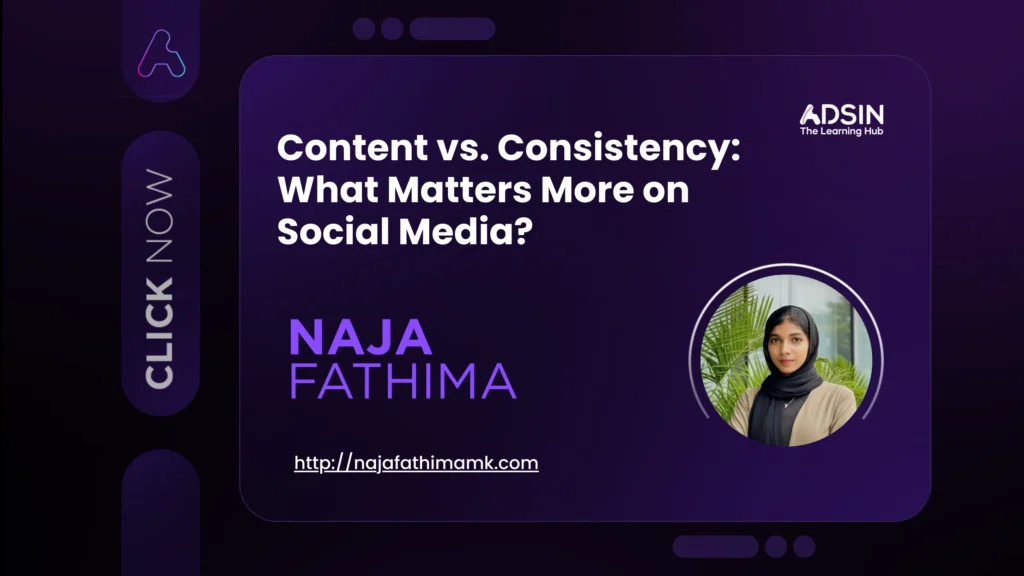
Content vs. Consistency: What Matters More on Social Media?

Content vs. Consistency: What Matters More on Social Media? In today’s fast-paced digital world, social media has become one of the most powerful tools for personal branding, business growth, and audience engagement. From small creators to large brands, everyone is competing for attention in a crowded online space. One of the most debated questions in social media marketing is: what matters more—content or consistency? The Foundation: Why Quality Content is King Content is the foundation of any social media strategy. It is what people see, read, watch, and engage with. High-quality content provides value, whether it is educational, entertaining, inspiring, or informative. Strong content helps build trust, showcase expertise, and create an emotional connection with the audience. Without good content, even the most consistent posting schedule will fail to attract meaningful engagement. Users scroll quickly, and only content that resonates with their needs or interests will make them stop and interact. Defining Brand Identity Through Storytelling Good content also helps define a brand’s identity and voice. Visual style, tone, messaging, and storytelling all contribute to how an audience perceives a brand or creator. When content is well-planned and audience-focused, it increases the chances of shares, saves, and comments. Algorithms also favor content that receives strong engagement, helping it reach a wider audience. This is why many marketers emphasize content quality as the most important factor in social media success. The Power of Visibility: Why Consistency Matters However, consistency plays an equally important role. Consistency does not only mean posting every day; it also includes maintaining a regular schedule, a uniform visual style, and a clear brand message. When you post consistently, you stay visible in your audience’s feed. Social media platforms reward active accounts by increasing their reach, as regular posting signals reliability and relevance. Inconsistent posting can cause audience interest to fade, no matter how good the content is. Building Trust and Brand Recall Consistency also builds familiarity and trust over time. When users know what to expect and see your content regularly, they are more likely to remember your brand and engage with it. For businesses, this can lead to stronger brand recall and customer loyalty. For creators, consistency helps grow a dedicated audience that looks forward to new posts. Even simple content can perform well if it is delivered consistently and aligned with audience expectations. The Perfection Trap: Quality vs. Quantity for Beginners The real challenge lies in choosing between content and consistency when resources are limited. Many beginners struggle with creating high-quality content frequently. In such cases, consistency often matters more than perfection. Posting simple but valuable content regularly is better than posting exceptional content once in a while and then disappearing. Over time, skills improve, and content quality naturally gets better with practice and feedback. Avoiding Audience Fatigue That said, consistency without quality has its limits. Posting frequently with low-value or repetitive content can lead to audience fatigue and unfollows. People engage with accounts that add something meaningful to their feed. This is why a balance between content and consistency is essential. A realistic content calendar that matches your capacity helps maintain both quality and regularity without burnout. Platform Dynamics and Audience Behavior Another important factor is platform and audience type. Fast-paced platforms: On Instagram, X (Twitter), and TikTok, consistency is especially important to stay relevant. Long-form platforms: On YouTube or blogs, content quality and depth may carry more weight, as users are willing to wait longer for valuable posts. Understanding where your audience spends time and how they consume content helps decide the right balance. Strategies for Long-Term Success In the long term, the most successful social media strategies focus on sustainable consistency with purposeful content. Instead of choosing one over the other, brands and creators should aim to create a system that supports both. Batch content creation, repurposing posts across platforms, and analyzing performance data can help maintain consistency without compromising quality. Planning content around audience needs and trends also ensures relevance. Conclusion: Finding the Perfect Balance In conclusion, content and consistency are not opposing forces but complementary elements of social media success. Content attracts and engages the audience, while consistency keeps you visible and memorable. If forced to choose, consistency may help you grow faster initially, but quality content is what sustains that growth. The real key lies in finding a balance that suits your goals, resources, and audience. Author: Naja FathimaDigital Marketing Strategist in Calicut Back Home For Admission Recent Post Recent Post Uncategorized Digital Marketing Graphic Designing Multimedia Marketing Zero To Hero Follow Us Instagram Facebook Linkedin Threads Youtube

Content vs. Consistency: What Matters More on Social Media? Read More »

Farsana's Guest blog Best digital marketing institute in Calicut

The Secret Sauce Behind Viral Social Media Campaigns

The Secret Sauce Behind Viral Social Media Campaigns In today’s digital-first world, going viral on social media is no longer just luck—it’s strategy. Every viral post, reel, or campaign you see online is backed by psychology, creativity, timing, and data. Brands that consistently go viral understand one thing clearly: people don’t share content because it’s perfect, they share it because it makes them feel something. Whether you’re a digital marketer, content creator, or business owner, understanding the secret sauce behind viral social media campaigns can help you grow faster, reach wider audiences, and build a powerful brand presence without spending huge advertising budgets. Let’s break down what truly makes a campaign go viral. Understanding Virality: More Than Just Views Virality is not just about getting thousands or millions of views. A campaign becomes viral when people actively engage with it—by liking, commenting, sharing, saving, or recreating it. Social media algorithms reward engagement, not just reach. The real goal of viral content is shareability. When users feel compelled to send your content to friends or repost it on their own profiles, your campaign enters the viral loop. This organic distribution is what separates viral campaigns from paid promotions. Emotion Is the Core Ingredient The strongest viral campaigns are emotionally driven. Content that triggers emotions performs far better than content that simply informs. The most shareable emotions include happiness, surprise, nostalgia, inspiration, humor, and even anger. People share content because it reflects their identity or feelings. A funny reel makes them look fun. An inspirational story makes them look thoughtful. A bold opinion makes them feel powerful. Viral campaigns tap into these emotional triggers intentionally. If your content doesn’t make someone feel something, it’s unlikely to be shared. Storytelling Over Selling One of the biggest mistakes brands make is focusing too much on selling instead of storytelling. Viral campaigns rarely feel like advertisements. Instead, they feel like stories people want to watch until the end. Great storytelling has three elements: a relatable problem, an emotional journey, and a satisfying resolution. Whether it’s a 15-second reel or a carousel post, storytelling keeps users hooked and increases watch time—an important factor for algorithms. When a brand tells a story instead of pushing a product, trust builds naturally, and shares follow automatically. Relatability Is Power People love content that makes them say, “This is so me.” Relatable content performs exceptionally well because it connects instantly with the audience’s daily life, struggles, humor, or habits. Campaigns that reflect real-life situations, trending conversations, or cultural moments feel authentic. They don’t look forced or overproduced. Authenticity increases trust, and trust increases sharing. Brands that sound human—not corporate—are more likely to go viral. Timing and Trend Awareness Even the best content can fail if posted at the wrong time. Viral campaigns often ride on trends—popular audio, hashtags, memes, or current events. Trend-based content works because the audience is already primed to engage. However, blindly copying trends doesn’t work. The key is relevance. Successful brands adapt trends to match their brand voice and message instead of forcing themselves into it. Being early to a trend gives you a competitive advantage before the platform becomes saturated. Platform-Specific Content Strategy Each social media platform has its own algorithm and content behavior. What goes viral on Instagram may not work on LinkedIn or X (Twitter). Viral campaigns are designed specifically for the platform they’re posted on. For example, Instagram favors reels with strong hooks and retention. LinkedIn favors storytelling and value-based content. YouTube Shorts favor fast-paced, visually engaging clips. Understanding platform behavior helps you optimize content length, format, captions, and visuals—boosting viral potential. The Hook: First 3 Seconds Matter Most On social media, attention is currency. If your content doesn’t grab attention within the first three seconds, users scroll away. Viral campaigns always start with a powerful hook. Hooks can be questions, bold statements, shocking facts, emotional visuals, or relatable situations. The goal is simple: stop the scroll. A strong hook increases watch time, which signals the algorithm to push your content to more users. Consistency Beats One-Time Virality One viral post can bring attention, but consistent content builds a brand. Many creators chase virality instead of consistency. The truth is, viral success often comes after multiple attempts. Brands that post regularly, analyze performance, and improve their strategy over time increase their chances of going viral. Algorithms favor accounts that show consistent activity and audience engagement. Virality is not an accident—it’s a result of repeated effort. Community Engagement Fuels Growth Viral campaigns don’t end after posting. Brands that reply to comments, encourage discussions, and engage with their audience extend the life of a post. Comments boost visibility. Shares expand reach. Saves indicate value. Every interaction sends positive signals to the algorithm. When people feel seen and heard, they become loyal followers—and loyal followers help content go viral. User-Generated Content and Participation Some of the biggest viral campaigns invite users to participate. Challenges, hashtags, duets, and remixable content encourage audience involvement. User-generated content creates a sense of belonging and turns followers into brand advocates. When people create content for your brand, your reach multiplies organically. Participation-based campaigns don’t just go viral—they build communities. Data-Driven Creativity While creativity is essential, data guides success. Viral marketers analyze metrics like reach, engagement, watch time, and audience behavior to understand what works. A campaign becomes repeatable when creativity meets analytics. By studying successful posts, marketers can identify patterns and refine future content strategies. Virality is both art and science. Conclusion: The Real Secret Sauce The secret sauce behind viral social media campaigns is not a single trick or formula. It’s the perfect blend of emotion, storytelling, relatability, timing, platform knowledge, consistency, and community engagement. Viral content feels human, authentic, and emotionally engaging. It doesn’t scream marketing—it sparks conversation. Brands that understand their audience deeply and create content with purpose are the ones that win the viral game. Instead of chasing virality, focus on creating meaningful content. When value meets emotion, virality follows naturally. Author: Farsana Mirza.TDigital Marketing

The Secret Sauce Behind Viral Social Media Campaigns Read More »

Shamil's Guest blog Best digital marketing institute in Calicut

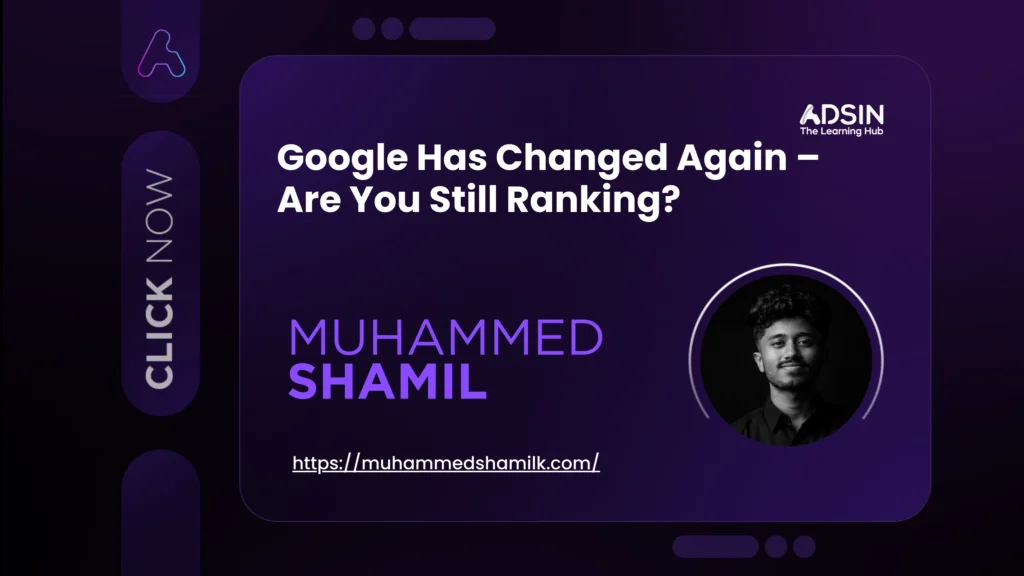
Google Has Changed Again – Are You Still Ranking?

Google Has Changed Again – Are You Still Ranking? out SEO, Google rolls out another update that changes the rules of the game. If your website traffic has suddenly dropped, rankings have shifted, or impressions are fluctuating, you’re not alone. Google has changed again — and the big question is, are you still ranking? Search engine updates are not random. Google’s main goal is simple: provide users with the most relevant, helpful, and trustworthy content. Every update is designed to reward quality and penalize shortcuts. Websites that focus only on keywords, outdated tactics, or copied content often see their rankings fall overnight. Why Google Keeps Changing Its Algorithm Google processes billions of searches every day. To keep results accurate, Google constantly updates its algorithm to improve user experience. This includes fighting spam, reducing low-quality content, and promoting websites that truly help users. In recent updates, Google has placed more importance on content quality, user intent, experience, and trust. This means SEO is no longer just about ranking for keywords — it’s about answering real questions in a meaningful way. If your site exists only to attract traffic without providing value, Google will eventually notice. Signs That Google’s Update Affected Your Rankings Many website owners don’t realize an update has hit them until it’s too late. Some common warning signs include a sudden drop in organic traffic, pages disappearing from top results, or keywords moving from page one to page three. Another clear sign is when your content still looks good, but competitors suddenly outrank you with better, more detailed pages. This usually means Google now prefers depth, clarity, and usefulness over basic optimization. Ranking losses don’t always mean your website is bad — it often means your content hasn’t evolved with Google. What Google Is Prioritizing Now Google’s recent changes focus heavily on helpful content. This means content should be written for humans first, not search engines. Pages that are genuinely informative, well-structured, and easy to read tend to perform better. User experience also plays a major role. Slow websites, poor mobile design, and confusing navigation can negatively impact rankings. Google wants users to stay longer, engage more, and find answers quickly. Another key factor is E-E-A-T — Experience, Expertise, Authoritativeness, and Trustworthiness. Google prefers content created by people who clearly understand their topic and demonstrate real-world knowledge. Why Old SEO Tricks No Longer Work There was a time when keyword stuffing, low-quality backlinks, and thin content could push a page to the top. That time is over. Google is now smarter than ever. Repeating the same keyword unnaturally, writing generic content, or publishing AI-generated text without value can hurt your rankings. Google’s systems can identify content created just to rank rather than to help users. If your SEO strategy hasn’t changed in the last few years, chances are Google has already moved past it. How to Recover and Improve Your Rankings The good news is that ranking drops are not permanent. Websites that adapt can recover — and even perform better than before. Start by auditing your content. Remove outdated information, improve clarity, and expand thin pages with useful insights. Focus on search intent. Ask yourself: does this page truly answer what the user is searching for? If not, rewrite it. Improve on-page SEO by optimizing headings, internal links, images, and readability. Make sure your website loads fast and works smoothly on mobile devices. Consistency is key. Google rewards websites that publish quality content regularly and keep it updated. The Future of Google Search Google will continue to evolve, and SEO will continue to change with it. Voice search, AI-powered results, and user behavior signals will play a bigger role in rankings. The websites that succeed will be those that adapt quickly and focus on real value. Instead of chasing every update, build a strong foundation. Create content that educates, solves problems, and builds trust. When Google changes again — and it will — your rankings will be more stable. Final Thoughts Google has changed again, but this isn’t something to fear. It’s an opportunity. Businesses that understand Google’s direction can use these changes to grow faster than competitors. If your rankings have dropped, don’t panic. Analyze, improve, and align your content with what users truly need. In the long run, helpful content always wins. Author: Muhammed ShamilDigital Marketing Expert in Wayanad Back Home For Admission Recent Post Recent Post Uncategorized Digital Marketing Graphic Designing Multimedia Marketing Zero To Hero Follow Us Instagram Facebook Linkedin Threads Youtube

Google Has Changed Again – Are You Still Ranking? Read More »

Musammil's Guest blog Best digital marketing institute in Calicut

Common Digital Marketing Mistakes That Kill Growth

Common Digital Marketing Mistakes That Kill Growth Digital marketing has become the backbone of modern business growth. From startups to established brands, everyone relies on online channels to reach audiences, generate leads, and drive conversions. However, despite investing time, money, and effort, many businesses fail to see results. The reason is not the lack of tools or platforms, but common digital marketing mistakes that silently block growth. Understanding these mistakes is the first step toward building strategies that actually work. Lack of a Clear Strategy and Goals One of the most damaging mistakes in digital marketing is operating without a clear strategy. Many businesses jump straight into running ads, posting on social media, or creating content without defining what they want to achieve. Without clear goals such as brand awareness, lead generation, or sales, campaigns become directionless. This results in wasted budgets, inconsistent messaging, and poor performance tracking. A strong digital marketing strategy aligns business objectives with measurable goals and ensures that every action contributes to long-term growth. Ignoring the Target Audience Another major growth killer is failing to truly understand the target audience. Many marketers create content or ads based on assumptions rather than data. When audience pain points, preferences, and behaviors are ignored, marketing messages fail to connect. This leads to low engagement, poor conversion rates, and high bounce rates. Successful digital marketing starts with audience research, including demographics, interests, search intent, and online behavior. When campaigns are audience-centric, growth becomes sustainable. Overlooking Search Engine Optimization (SEO) SEO is often treated as an optional or one-time activity, which is a critical mistake. Businesses that ignore SEO miss out on consistent organic traffic that compounds over time. Poor keyword research, low-quality content, slow website speed, and lack of mobile optimization can severely impact search rankings. Without SEO, brands become overly dependent on paid ads for visibility. Long-term growth requires continuous SEO efforts that focus on valuable content, technical optimization, and user experience. Chasing Trends Without Purpose Digital marketing trends change rapidly, and while staying updated is important, blindly following trends can harm growth. Many brands jump onto new platforms, formats, or tactics without evaluating whether they align with their goals or audience. This results in scattered efforts and diluted brand identity. Trends should support a well-defined strategy, not replace it. Sustainable growth comes from consistency and relevance, not trend-hopping. Poor Content Quality and Inconsistency Content is at the heart of digital marketing, yet poor-quality content remains a common mistake. Content that lacks value, originality, or clarity fails to build trust or authority. Additionally, inconsistent posting schedules confuse audiences and weaken brand recall. Whether it is blogs, videos, emails, or social media posts, content should educate, engage, or solve problems. High-quality and consistent content positions a brand as a reliable source and drives organic growth over time. Not Optimizing for Mobile Users With the majority of users accessing the internet through mobile devices, ignoring mobile optimization is a serious growth blocker. Websites that load slowly, have poor navigation, or are not mobile-responsive create frustrating user experiences. This leads to higher bounce rates and lower conversions. Mobile optimization is not just about design but also about speed, readability, and usability. Brands that prioritize mobile-first experiences gain a competitive advantage in today’s digital landscape. Mismanaging Paid Advertising Campaigns Paid ads can accelerate growth, but only when managed correctly. A common mistake is running ads without proper targeting, testing, or budget control. Many businesses focus only on impressions or clicks rather than meaningful metrics like conversions and return on ad spend. Poor ad creatives, weak landing pages, and lack of A/B testing result in wasted ad budgets. Effective paid advertising requires continuous monitoring, optimization, and alignment with business goals. Ignoring Data and Analytics Digital marketing offers powerful analytics, yet many marketers fail to use data effectively. Decisions based on gut feeling instead of performance data often lead to repeated mistakes. Ignoring metrics such as traffic sources, conversion rates, engagement, and customer journeys limits growth opportunities. Data-driven marketing allows businesses to identify what works, what doesn’t, and where improvements are needed. Growth-driven brands treat analytics as a decision-making tool, not just a reporting feature. Weak Conversion Optimization Driving traffic alone does not guarantee growth. Many businesses focus heavily on attracting visitors but neglect conversion optimization. Poor landing page design, unclear calls to action, complicated forms, and lack of trust signals reduce conversion rates. Even high-quality traffic can fail to convert if the user experience is weak. Optimizing for conversions ensures that marketing efforts translate into actual business results, making growth more efficient. Lack of Consistent Branding and Messaging Inconsistent branding across platforms confuses audiences and weakens brand identity. Using different tones, visuals, or messages on various channels reduces trust and recognition. Digital marketing growth depends on building a strong, memorable brand. Consistent messaging helps audiences understand what the brand stands for and why they should choose it. A unified brand presence strengthens long-term growth and loyalty. Conclusion Digital marketing failures rarely happen overnight. Growth is usually killed by small, repeated mistakes that go unnoticed. From unclear strategies and poor audience understanding to ignoring SEO and data, these errors prevent businesses from reaching their full potential. Avoiding these common digital marketing mistakes requires planning, consistency, and a data-driven mindset. When brands focus on strategy, audience value, and continuous optimization, digital marketing becomes a powerful engine for sustainable growth rather than a costly experiment. Author: Muhammed Musammil KTFreelance Digital Marketer in Calicut Back Home For Admission Recent Post Recent Post Uncategorized Digital Marketing Graphic Designing Multimedia Marketing Zero To Hero Follow Us Instagram Facebook Linkedin Threads Youtube

Common Digital Marketing Mistakes That Kill Growth Read More »

Niya Shafi's Guest blog Best digital marketing institute in Calicut

The Dark Side of Digital Marketing Nobody Talks About

The Dark Side of Digital Marketing Nobody Talks About Digital marketing is often painted as a glamorous industry viral campaigns, overnight growth, massive reach, and data-driven success stories. Social media feeds are filled with screenshots of analytics dashboards, celebratory posts about ROAS, and claims of “10x growth in 30 days.” On the surface, it looks like a dream profession and a magic solution for businesses. But behind the buzzwords, dashboards, and dopamine-driven metrics lies a darker reality—one that is rarely discussed openly.   Digital marketing, while powerful, has ethical, psychological, and strategic downsides that impact businesses, marketers, and consumers alike. Ignoring these issues doesn’t make them disappear; it only makes the system more fragile. This blog explores the uncomfortable truths of digital marketing that nobody really talks about. 1. The Obsession With Vanity Metrics One of the biggest dark sides of digital marketing is the industry’s obsession with vanity metrics. Likes, impressions, views, followers, and reach often become the primary indicators of success—even when they don’t translate into real business value.   Many brands celebrate a post going viral without asking the most important question: Did it bring the right audience? High engagement can feel rewarding, but engagement without intent is just noise. Businesses end up chasing numbers instead of outcomes like conversions, loyalty, or long-term brand equity. This obsession creates a false sense of growth. Brands feel like they are winning, while sales, retention, and trust quietly stagnate. 2. Manipulation Disguised as Marketing At its core, digital marketing is about influence. But the line between influence and manipulation has become dangerously thin. Dark patterns—such as misleading CTAs, fake urgency, exaggerated claims, and emotional exploitation—are increasingly normalized.   Countdown timers that reset, “only 2 slots left” messages that never end, and testimonials that are selectively framed all push users into decisions they may not fully understand. While these tactics may boost short-term conversions, they erode trust over time. When marketing focuses more on tricking users than helping them, brands sacrifice long-term credibility for quick wins. 3. Burnout Culture Among Marketers The dark side doesn’t only affect consumers—it deeply impacts marketers themselves. The digital marketing industry runs on constant pressure: daily content, weekly reports, monthly targets, and ever-changing algorithms.   Marketers are expected to stay creative, analytical, strategic, and available 24/7. Social media never sleeps, and neither do expectations. The result? Chronic burnout, anxiety, and a sense of never doing “enough.”Because results are public—likes, comments, shares—failure feels visible and personal. This creates a toxic environment where self-worth becomes tied to performance  metrics rather than skill or growth. 4. Algorithm Dependency and Loss of Control Businesses often believe they “own” their digital presence, but in reality, they are at the mercy of platforms. Algorithms decide who sees your content, when, and how often. A single algorithm update can destroy years of organic growth overnight. Pages that once reached thousands suddenly struggle to reach hundreds. Brands invest heavily in platforms they don’t control, building audiences they can lose without warning. This dependency creates instability. Businesses confuse platform success with business success, forgetting that algorithms are designed for platform goals—not brand sustainability. 5. Data Privacy and Ethical Concerns Digital marketing runs on data—user behavior, interests, location, habits, and preferences. While data enables personalization, it also raises serious privacy concerns. Many users don’t fully understand how much data they are giving away or how it is being used. Consent banners are often designed to confuse rather than inform. Behind the scenes, user behavior is tracked, analyzed, and monetized at scale.   This raises ethical questions: Are we respecting users, or exploiting their digital footprints? Is personalization helping users, or manipulating them? As regulations tighten, brands that rely on invasive practices may face not just legal consequences, but reputational damage. 6. Short-Term Thinking Over Long-Term Strategy Digital marketing encourages speed—quick campaigns, instant results, rapid testing. While agility is valuable, it often leads to short-term thinking. Brands jump from trend to trend, platform to platform, without a clear strategy. One month it’s reels, the next it’s AI content, then influencer collaborations. Consistency suffers, brand voice gets diluted, and audiences get confused. Marketing becomes reactive instead of intentional. Instead of building a strong brand foundation, businesses chase what’s working right now, ignoring sustainability. 7. Fake Authority and the Rise of “Gurus” The digital marketing space is flooded with self-proclaimed experts promising guaranteed success. Courses, webinars, and “secret strategies” are marketed aggressively, often without real-world proof. This creates unrealistic expectations for both businesses and beginners. New marketers feel inadequate when instant success doesn’t happen. Businesses believe growth should be fast and effortless, and lose patience with ethical, long-term approaches. The result is a cycle of misinformation, disappointment, and distrust in the industry itself. 8. Content Overload and Audience Fatigue Every brand is told to “post consistently.” The outcome? An overwhelming flood of content. Users scroll through hundreds of ads, posts, reels, and emails every single day. Instead of standing out, most content blends into the background. Audiences become numb, skeptical, and harder to engage. Attention spans shrink, and meaningful connections are replaced by fleeting impressions. Ironically, the more brands post without purpose, the less impact they make. 9. The Illusion of Automation and AI Automation tools and AI have transformed digital marketing—but they’ve also introduced new risks. Over-automation removes the human element from communication. Generic replies, robotic content, and emotionless campaigns damage authenticity. When everyone uses the same tools, templates, and prompts, creativity suffers. Brands start sounding the same, losing their uniqueness in a sea of algorithm-friendly content. AI should assist strategy—not replace empathy, judgment, and human understanding. 10. Erosion of Trust Between Brands and Consumers All these issues lead to one major consequence: loss of trust. Consumers are more skeptical than ever. They question ads, reviews, influencers, and brand promises. Once trust is broken, no amount of retargeting or discounts can fix it. Digital marketing can attract attention, but only honesty and value can sustain relationships.Brands that ignore this reality may win clicks—but lose people. Conclusion Digital

The Dark Side of Digital Marketing Nobody Talks About Read More »

Nusaif's Guest blog Best digital marketing institute in Calicut

AI Tools That Are Replacing Jobs in 2026 (And How to Stay Relevant)

AI Tools That Are Replacing Jobs in 2026 (And How to Stay Relevant) Artificial Intelligence is no longer a future promise—it is a present-day reality reshaping the global workforce. By 2026, AI has moved far beyond being a simple assistant to humans. It is now performing tasks independently, often faster, cheaper, and with fewer errors than traditional human workflows.   This rapid evolution has created uncertainty across industries, especially among professionals whose jobs are built around repetitive or execution-focused tasks. However, the real issue is not AI itself, but how we respond to it. Why AI Is Replacing Jobs Faster Than Ever The replacement of jobs by AI is accelerating mainly due to cost efficiency, speed with accuracy, and accessibility. AI tools operate 24/7 without salaries, sick leave, or burnout, offering businesses consistent output at lower costs. Tasks such as analyzing data, generating reports, creating content, or responding to customers—once time-consuming—are now completed in seconds.   At the same time, AI is no longer limited to large corporations. Affordable tools are now widely available to startups, small businesses, and individual creators, accelerating adoption across nearly every industry. Job Roles Most Affected by AI in 2026 As AI adoption grows, roles dependent on routine execution are shrinking or disappearing. These include: Basic content writing focused on volume Entry-level graphic design with repetitive visuals Customer support roles handling FAQs and tracking Data entry and clerical work Bookkeeping and routine accounting Posting-only social media management AI tools such as ChatGPT, Canva AI, Midjourney, chatbots, RPA systems, and AI-powered accounting software now handle these tasks efficiently. However, this shift does not mean humans are becoming irrelevant. Instead, it reflects a change in what kind of human value truly matters. AI Replaces Tasks, Not Humans AI does not replace people—it replaces tasks. Jobs built mainly around repeatable actions are the most vulnerable.   For example, writers focused purely on output volume face declining demand as AI can instantly generate content. Entry-level designers creating repetitive visuals are being replaced by AI design tools. Customer support and data entry roles are increasingly automated as AI systems can process information quickly and accurately. How Traditional Roles Are Evolving Even professions once considered secure, such as accounting, are changing. AI now handles expense tracking, invoicing, tax calculations, and reporting, pushing accountants toward advisory and strategic roles.   The same evolution applies to social media management. Professionals who only schedule posts are losing relevance, while those skilled in audience psychology, branding, and analytics are increasingly in demand. New Career Opportunities Created by AI At the same time, AI is creating new career paths, including: AI prompt engineers AI tool specialists Automation experts Digital strategists AI trainers Human–AI content editors These professionals do not compete with AI; they work alongside it. This reinforces an important truth: AI replaces those who refuse to adapt, not those who evolve.   Human strengths such as emotional intelligence, ethical judgment, leadership, cultural understanding, and creativity shaped by lived experience remain irreplaceable—and increasingly valuable. How to Stay Relevant in the Age of AI Staying relevant in 2026 requires a mindset shift. Instead of fearing AI, professionals must learn how to use it. Those who understand AI tools are more employable than those who avoid them.   AI should be viewed as an extension of human capability, not a threat. Moving Beyond Execution Roles While AI excels at performing tasks, humans add value through strategy, decision-making, creative direction, and emotional connection.   A useful way to assess long-term relevance is asking: What decisions do I make that AI cannot? Where do I add judgment, context, or empathy? The Power of Skill Stacking Relying on a single skill is increasingly risky. Combining complementary skills—such as creativity with strategy or business knowledge with AI tools—creates a strong professional advantage.   Hybrid professionals who can bridge disciplines are in the highest demand. Problem-solving remains a timeless human strength: AI can generate answers, but humans define the right problems to solve. The Future of Work in 2026 Businesses today are not just looking for people who execute tasks. They seek adaptable learners, strategic thinkers, AI-literate professionals, and individuals who bring ideas, save time, and create value.   The future does not belong to humans or machines alone—it belongs to humans who know how to use machines intelligently. AI replacing jobs is not a warning; it is an invitation to evolve. Those who choose growth will shape what comes next. Author: Nusaif AbdullaDigital Marketing Strategist In Calicut Back Home For Admission Recent Post Recent Post Uncategorized Digital Marketing Graphic Designing Multimedia Marketing Zero To Hero Follow Us Instagram Facebook Linkedin Threads Youtube

AI Tools That Are Replacing Jobs in 2026 (And How to Stay Relevant) Read More »

Rifana's Guest blog Best digital marketing institute in Calicut

The Future of SEO: What Marketers Must Prepare For

The Future of SEO: What Marketers Must Prepare For SEO has changed more in the last few years than it did in the decade before that. What once worked—stuffing keywords into content, chasing backlinks, and publishing content just for the sake of ranking—no longer delivers sustainable results. Search engines have become smarter, users have become more demanding, and competition has intensified across every industry.   Today, SEO is less about pleasing algorithms and more about understanding people. Google’s updates make one thing clear: the future of SEO belongs to brands and marketers who focus on real value, trust, and user experience.   If you’re a marketer, business owner, or content creator, preparing for the future of SEO is not optional. It’s essential. Let’s explore what’s changing, why it matters, and how you can stay ahead. 1. AI Has Completely Changed How Search Works Artificial intelligence now sits at the core of modern search engines. Google doesn’t just scan pages for keywords anymore—it understands context, intent, and relevance at a much deeper level.   This means SEO is no longer about gaming the system. AI-powered algorithms can identify whether content is genuinely helpful or just written to rank. Thin content, recycled ideas, and generic blog posts are being pushed out in favor of content that actually answers user questions.   For marketers, this means a mindset shift. Instead of asking “How do I rank for this keyword?”, the better question is: “How can I provide the most useful answer to this search?”   Content that reflects real knowledge, experience, and clarity is what AI-driven search rewards. The future of SEO belongs to those who focus on value first, optimization second. 2. Search Intent Is More Important Than Keywords Keywords still play a role, but they are no longer the foundation of SEO. Search intent—the reason behind a search—is now far more important.   Users search with different goals: To learn something To compare options To find a specific brand To make a purchase Search engines understand these intentions better than ever. If your content doesn’t align with what users expect, it simply won’t rank—no matter how many keywords you add.   That’s why modern SEO focuses on topic relevance, not individual keywords. Creating in-depth content that covers a topic fully, answers related questions, and guides users naturally through their journey is far more effective than targeting one keyword per page. SEO in the future is about being relevant, not repetitive. 3. Trust, Experience, and Credibility Will Decide Rankings One of the most important shifts in SEO is Google’s focus on E-E-A-T: Experience, Expertise, Authoritativeness, and Trustworthiness. Search engines want to promote content from sources that users can trust. This is especially important in industries like health, finance, education, and digital marketing.   To build trust through SEO, marketers should: Share real experiences and case studies Clearly mention authors and credentials Keep information accurate and updated Maintain transparency across platforms Anonymous, faceless content is losing ground. The future belongs to brands and individuals who show who they are, what they know, and why they’re qualified to speak on a topic. SEO is no longer separate from reputation—it’s directly connected to it. 4. Voice Search Is Changing How Content Is Written With the rise of smart assistants and voice-enabled devices, voice search is becoming a regular part of how people find information. And voice searches sound very different from typed queries.   People don’t speak in keywords. They ask questions. For example: Typed search: “SEO trends 2026” Voice search: “What SEO trends should marketers focus on in 2026?” To adapt, content needs to sound more natural and conversational. Pages that directly answer questions, use simple language, and follow a logical structure are more likely to appear in voice search results and featured snippets.   The future of SEO writing looks less like a textbook and more like a helpful conversation. 5. Visual Search and Image SEO Are Becoming Powerful Search is no longer limited to text. Visual search allows users to search using images, screenshots, or photos—and this trend is growing rapidly.   For marketers, this means images are no longer just decorative. They’re searchable assets.   Optimizing images involves: Using high-quality visuals Writing meaningful alt text Choosing descriptive file names Compressing images for faster loading For eCommerce brands, designers, and content creators, visual SEO offers a new way to attract traffic and stand out in competitive markets. Ignoring image optimization in the future will mean missing out on a major traffic source. 6. User Experience Is Now a Ranking Factor Google has made it clear: user experience matters. Factors like page speed, mobile responsiveness, visual stability, and ease of navigation directly affect rankings. If users land on your site and leave immediately because it’s slow or confusing, search engines notice.   Future-ready websites focus on: Mobile-first design Fast loading times Clean layouts Easy navigation SEO and web design can no longer work separately. A well-optimized website must also feel good to use.   In the future, SEO success will depend just as much on design and usability as it does on content. 7. Zero-Click Searches Are the New Normal Many users now get answers directly from search results without clicking on any website. Featured snippets, knowledge panels, and “People Also Ask” sections provide instant information.   While this reduces clicks, it increases visibility and authority. Being featured as the answer builds trust and brand recognition—even if users don’t visit your site immediately.   To benefit from zero-click searches, marketers should: Structure content clearly Answer questions concisely Use schema and structured data SEO is no longer just about traffic—it’s about being the most trusted source. 8. Content Quality Will Always Beat Content Quantity Publishing more content does not guarantee better rankings. In fact, low-quality or repetitive content can harm your site’s performance.   Search engines are now very good at identifying: Thin content AI-generated content without value Rewritten or duplicated ideas The future of SEO favors depth, originality, and usefulness. One strong,

The Future of SEO: What Marketers Must Prepare For Read More »

Niha's Guest blog Best digital marketing institute in Calicut

AI in Digital Marketing: Friend, Tool, or Future Boss?

AI in Digital Marketing: Friend, Tool, or Future Boss? Artificial Intelligence (AI) is no longer a futuristic concept. It’s already here—quietly reshaping how brands connect with people, how campaigns are built, and how decisions are made. From chatbots replying to customers at midnight to AI tools writing ad copy in seconds, digital marketing has entered a new era. But this rapid growth raises an important question: – Is AI a helpful friend, a powerful tool, or a future boss that could replace human marketers? Let’s break it down in a simple, honest, and practical way. Understanding AI in Digital Marketing AI in digital marketing refers to technologies that can analyze data, learn from behavior, and make decisions with minimal human intervention. These systems use machine learning, natural language processing, and predictive analytics to improve marketing performance. In simple terms, AI helps marketers: Understand audiences better Automate repetitive tasks Predict trends and customer behavior Personalize content at scale What once took days or weeks can now be done in minutes. AI as a Friend: Making Marketers’ Lives Easier For many marketers, AI feels like a supportive teammate. It reduces workload and helps focus on creativity and strategy instead of manual tasks. 1. Better Audience Understanding AI analyzes massive amounts of data—website visits, social media interactions, purchase history, and more. This helps marketers understand: What customers want When they are most active Which content performs best Instead of guessing, marketers can make data-driven decisions. 2. Personalization at Scale Today’s consumers expect personalized experiences. AI makes this possible by: Showing personalized ads Sending customized email content Recommending products based on behavior This level of personalization builds trust and improves conversion rates. 3. Faster Content Creation AI tools can generate: Blog outlines Ad headlines Social media captions Email subject lines While humans still refine and add emotion, AI speeds up the process significantly. 4. Improved Customer Support AI-powered chatbots can: Answer FAQs instantly Guide users through websites Provide 24/7 support This improves customer satisfaction while reducing support costs. 👉 As a friend, AI saves time, boosts efficiency, and supports smarter marketing decisions. AI as a Friend: Making Marketers’ Lives Easier AI is not magic. It’s a tool—and like any tool, its impact depends on how it’s used. 1. Data Without Strategy Is Useless AI can analyze data, but it cannot: Understand brand emotions Feel customer pain points deeply Define long-term vision Marketers still need to guide AI with clear goals and strategies. 2. Creativity Still Needs Humans AI can write content, but: It lacks originality It doesn’t understand cultural emotions fully It cannot tell real human stories Strong branding, storytelling, and emotional connection still require human creativity. 3. Bias and Accuracy Issues AI learns from existing data. If the data is biased or incorrect, AI results will be flawed. This can lead to: Wrong targeting Misleading ads Ethical concerns Human supervision is essential to avoid these issues. 4. Over-Automation Can Feel Robotic Too much automation can make brands feel cold and impersonal. Customers still value: Human tone Authentic communication Real conversations 👉 As a tool, AI is powerful—but it must be guided, monitored, and balanced with human touch. AI as a Future Boss: Should Marketers Be Worried? This is the biggest fear in the industry: Will AI replace digital marketers? The short answer: Not completely.The honest answer: It will replace marketers who don’t adapt. Jobs That May Reduce AI can easily handle: Basic content generation Data analysis Ad optimization Simple reporting Marketers who rely only on repetitive tasks may feel the impact. How AI Is Transforming Key Areas of Digital Marketing   SEO & Content Marketing Paid Advertising Social Media Marketing Email Marketing Ethical Concerns and Responsible Use of AI With power comes responsibility. AI raises important ethical questions: Data privacy Fake content and misinformation Manipulative targeting Transparency Brands must use AI responsibly to maintain trust and credibility. So… Friend, Tool, or Future Boss? The truth is—AI is all three, depending on how you use it. Friend when it supports and simplifies work Tool when guided with strategy and creativity Boss only if marketers refuse to adapt AI is not here to replace humans—it’s here to enhance human potential. The future of digital marketing belongs to those who can combine technology with creativity, data with emotion, and automation with authenticity. Final Thought AI won’t steal your job.But someone using AI is smarter than you might be. So learn it. Use it. Control it. And let AI work for you—not over you. Author: Fathima Niha K.PDigital Marketing Strategist In Calicut Back Home For Admission Recent Post Recent Post Uncategorized Digital Marketing Graphic Designing Multimedia Marketing Zero To Hero Follow Us Instagram Facebook Linkedin Threads Youtube

AI in Digital Marketing: Friend, Tool, or Future Boss? Read More »

Dilna's Guest blog Best digital marketing institute in Calicut

Why Visual Content Is the Backbone of Successful Digital Marketing

Why Visual Content Is the Backbone of Successful Digital Marketing In today’s fast-paced digital world, attention has become the most valuable currency. With users scrolling through hundreds of posts, ads, and videos every day, businesses have only a few seconds to make an impact. This is where visual content plays a powerful role. From social media posts and website banners to ads and videos, visual elements are the backbone of successful digital marketing. Digital marketing without strong visuals is like a message without emotion. Graphic design transforms ideas into engaging experiences, helping brands communicate faster, better, and more memorably. In this blog, we’ll explore why visual content is so important, how it supports digital marketing goals, and how businesses can use it effectively. The Power of Visual Communication The human brain processes visuals 60,000 times faster than text. This is why images, videos, and graphics instantly capture attention while long paragraphs are often ignored. Visual content simplifies complex information and delivers messages quickly. For example: A well-designed infographic explains data faster than a long article A short video tells a brand story more effectively than plain text A strong poster design instantly creates brand recall In digital marketing, where competition is intense, visuals help brands stand out and connect emotionally with their audience. Visual Content and Brand Identity Brand identity is more than just a logo. It includes colors, fonts, layouts, imagery style, and overall design consistency. Visual content ensures that a brand looks recognizable across all digital platforms. Consistent graphic design helps: Build trust and credibility Create strong brand recall Make the brand look professional Differentiate from competitors When users repeatedly see the same visual style on social media, websites, ads, and emails, they begin to remember and trust the brand. This consistency is essential for long-term digital marketing success. Role of Visuals in Social Media Marketing Social media is a visual-first platform. Posts with images or videos receive significantly more engagement than text-only posts. Platforms like Instagram, Facebook, LinkedIn, and even X prioritize visual content in their algorithms. Graphic design supports social media marketing by: Increasing likes, shares, and comments Improving brand recognition Making content more shareable Communicating messages quickly Well-designed reels, carousels, posters, and thumbnails help brands grab attention in crowded feeds. Without strong visuals, even the best content strategy may fail to perform. Visual Content Improves Advertising Performance In digital advertising, visuals directly impact click-through rates and conversions. Whether it’s Google Ads, Facebook Ads, or display advertising, users decide within seconds whether to click or ignore an ad. Good graphic design in ads helps: Capture attention instantly Communicate offers clearly Increase ad recall Improve conversion rates Poorly designed ads with cluttered layouts or weak visuals often lead to low engagement and wasted ad spend. High-quality design ensures that marketing budgets deliver real results. Website Design and User Experience A website is often the first impression of a business. Visual content plays a major role in how users perceive and interact with a website. Strong website design improves: User experience (UX) Time spent on site Bounce rate Trust and credibility Clean layouts, balanced colors, readable typography, and engaging visuals make navigation easier and content more enjoyable. A visually appealing website supports SEO and helps convert visitors into customers. AdsIn provides structured guidance, industry-relevant tools, and up-to-date strategies to help learners build confidence and practical expertise in digital advertising. Visual Content and SEO Many people think SEO is only about keywords and content, but visuals also play an important role. Optimized images, videos, and design elements improve website performance and user engagement. Visual content supports SEO by: Reducing bounce rate Increasing dwell time Improving page experience Enhancing content understanding Image optimization, proper alt text, fast loading design, and mobile-friendly layouts help search engines rank websites better. This shows how graphic design and digital marketing work together. Video Content: The King of Digital Marketing Video is currently the most powerful form of visual content. Short videos, reels, explainer videos, and brand stories dominate digital platforms. Benefits of video content: Higher engagement than images or text Better storytelling Strong emotional connection Increased conversion rates From product demos to educational content, video marketing helps brands communicate effectively. Graphic design plays a key role in video thumbnails, animations, transitions, and overall visual appeal. Infographics and Visual Storytelling Infographics combine design and information to tell a story visually. They are highly shareable and easy to understand, making them a valuable digital marketing asset. Infographics are useful for: Explaining complex data Educating audiences Building authority Increasing backlinks and shares Visual storytelling through design helps brands connect with audiences on a deeper level, making content more memorable. Importance of Professional Graphic Design While many tools allow anyone to create designs, professional graphic design brings strategy, creativity, and brand alignment. Designers understand color psychology, layout balance, typography, and visual hierarchy. Professional design ensures: Clear communication Strong brand positioning Better marketing performance Long-term brand growth Digital marketing strategies become more effective when supported by thoughtful, high-quality visuals. Conclusion Visual content is no longer optional in digital marketing—it is essential. From social media and ads to websites and videos, graphic design shapes how audiences perceive and engage with brands. Strong visuals capture attention, build trust, improve engagement, and drive conversions. Successful digital marketing relies on the perfect blend of strategy and creativity. When businesses invest in high-quality visual content, they don’t just market products—they create experiences. In a digital world filled with noise, powerful visuals are what make brands unforgettable. Author: Dilna ShirinBest Digital Marketer in Calicut  Back Home For Admission Recent Post Recent Post Uncategorized Digital Marketing Graphic Designing Multimedia Marketing Zero To Hero Follow Us Instagram Facebook Linkedin Threads Youtube

Why Visual Content Is the Backbone of Successful Digital Marketing Read More »

Rifli's Guest blog Best digital marketing institute in Calicut

Why Digital Advertising Skills Are Essential in Today’s Marketing World

Why Digital Advertising Skills Are Essential in Today’s Marketing World What Is Digital Advertising? Digital advertising refers to paid promotions run on online platforms such as Google, Facebook, Instagram, YouTube, and other digital channels. These ads allow businesses to target users based on search intent, interests, location, age, and online behavior. Unlike traditional advertising, digital ads provide instant data on performance, helping marketers make smarter decisions. Why Digital Advertising Is Important for Businesses Digital advertising helps businesses grow faster by reaching the right audience at the right time. Whether it’s increasing brand awareness, generating leads, or driving sales, paid ads deliver quick and measurable results. Businesses can control budgets, track conversions, and optimize campaigns in real time, making digital advertising one of the most cost-effective marketing methods available today. Popular Digital Advertising Platforms You Should Learn Learning the right platforms is essential for anyone entering digital marketing: Google Ads – Ideal for reaching users actively searching for products or services Meta Ads (Facebook & Instagram) – Best for brand awareness, engagement, and remarketing YouTube Ads – Powerful for video storytelling and audience building Display & Remarketing Ads – Helps re-engage users who have already interacted with a brand Each platform has unique ad formats and strategies that every digital marketer should understand. Key Skills You Gain by Learning Digital Advertising Digital advertising teaches valuable skills that are highly demanded in the industry: Audience research and targeting Ad copywriting and creative design Budget planning and campaign strategy Data analysis and performance tracking Conversion optimization and ROI measurement These skills are useful for careers, freelancing, and business growth. Why Digital Advertising Is a High-Demand Career Skill With more businesses moving online, the demand for skilled ad specialists is growing rapidly. Companies are constantly looking for professionals who can manage ad campaigns and deliver results. Learning digital advertising opens doors to roles such as: Digital Marketing Executive Performance Marketer Google Ads Specialist Social Media Ads Manager Freelance Digital Advertiser How Adsin Helps You Master Digital Advertising At AdsIn, learning goes beyond theory. The focus is on practical, real-world training that prepares students for the industry. Learners gain hands-on experience by working with live ad accounts, understanding campaign setup, analyzing performance, and optimizing ads for better results. AdsIn provides structured guidance, industry-relevant tools, and up-to-date strategies to help learners build confidence and practical expertise in digital advertising. Who Can Learn Digital Advertising at Adsin? Digital advertising is suitable for: Students and freshers Working professionals Business owners Freelancers and entrepreneurs Anyone interested in digital marketing No prior experience is required, just a willingness to learn and grow. Author: RifliDigital Marketing Expert in Malappuram Back Home For Admission Recent Post Recent Post Uncategorized Digital Marketing Graphic Designing Multimedia Marketing Zero To Hero Follow Us Instagram Facebook Linkedin Threads Youtube

Why Digital Advertising Skills Are Essential in Today’s Marketing World Read More »